By John Andrews
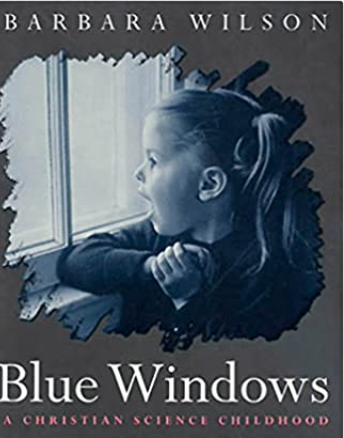
“How can I, so harmed by this church, still find it the source of so much meaning in my life?” That’s the question award-winning author and translator Barbara Wilson, nearing 50, sets out to explore in Blue Windows: A Christian Science Childhood, a dramatic memoir of her experiences up to about age 15.
As a story, I found it engaging and moving. As a venture in self-knowledge, I found it admirably discerning and honest. For any of us working to make sense of how Christian Science helped shape the person we became, Wilson’s powerful book deserves a place on our shelves—alongside Linda Kramer’s Perfect Peril, Lauren Hunter’s Leaving Christian Science, Lucia Greenhouse’s Father-Mother God, and Caroline Fraser’s God’s Perfect Child.
Blue Windows reads like a tragic novel, yet all the characters and events are real. Little Barbara is a bright, shy, sensitive tomboy growing up in California and Michigan in the 1950s. Bruce is her younger brother and sometimes best pal. Ellen, their mother, is an earnest, class-taught Christian Scientist. Cecil, their father, starts as a mild agnostic but becomes a militant Lutheran. Finally, Grandma Faith Lane is a strong-willed, no-nonsense practitioner and matriarch of the family.
Uncle Andrew, Ellen’s brother, secretly molests Barbara and is later institutionalized with schizophrenia. When Cecil remarries after Ellen’s death, we meet Bettye, the coarse, cruel stepmother, and Mike, her worldly-wise teenage son.
Ellen Wilson’s harrowing three-year battle with mental illness and breast cancer, which claimed her life when Barbara was only 12, is the book’s focal point, both as a narrative and as an exploration of religious belief.
After worsening insanity and repeated suicide attempts, one of which disfigured her face, the young mother’s death shattered the daughter’s snug, sunlit world. It also disproved her rosy worldview, whereby faith in an all-good God was supposed to guarantee the faithful a happy life. The disillusioned girl began to realize and she was never the same again.
The blue windows of the book’s title allude to a children’s article in the Christian Science Sentinel that had deeply impressed the precocious Barbara. They represent an outlook on life where sorrow, suffering, and struggle predominate, and which Christian Science teaches us to reject for a rose-window outlook where all is always well. Reality though is decidedly blue, she concludes in her grief.
Even so, breaking with the ingrained CS life patterns takes Wilson several more years—which will sound familiar to many of us who have had to make that drawn-out transition. The recurrent nostalgia for Science’s simple, sweet, secure, emotional cocoon persists with her for decades after that.
Intertwined with her personal story, Wilson gives us a well-researched, meticulously accurate, and skillfully constructed account of how Christian Science arrived on the American scene and how Mrs. Eddy obtained a huge following despite some of her unlovely traits. She finds things to admire and deplore in both the religion and its founder.
Wilson speculates how CS may have contributed to her mother’s disease and death yet refrains from casting blame. The whole book avoids simplistic good guys vs. bad guys framework regarding either individuals or institutions. Instead, she seems to say that everyone had reasons for acting as they did, and labels only obscure the understanding we all must strive for.
“Scrupulously fair-minded,” a New York reviewer called Blue Windows when it came out in 1997, and I warmly agree. Wilson is a remarkable human being, someone I’d enjoy knowing.
Her eclectic spirituality (tinged with Buddhism), feminist preoccupations, left-liberal politics, and lesbian sexual orientation in later chapters won’t be to every reader’s taste. They are part of the introspection she distills from retrospection, shall we say—to play off the title of Eddy’s autobiography, where far less depth is achieved than here in Wilson’s story.
If we could meet for coffee sometime, I’d like to ask Barbara about her mid-teens experience of gradually “acknowledging that the all-loving, all-knowing, all-powerful, all-good God I had known as a child did not exist.” It was to be a turning point, she adds, for “I knew that once I let go of this God, the god of my childhood, I would not be able to believe in another one.”
It’s the exact conclusion that many people, perhaps most people, who leave Christian Science settle upon. I know that very well. But I also know from my own experience that it doesn’t have to be that way, as you may see from yours. The true and living God is still out there, waiting to welcome former Christian Scientists home as the adopted brothers and sisters of his crucified and resurrected Son, Jesus Christ.
Even now, after all these years, all the wandering paths you may have walked, He is there. He’s left the light on for you. Do you know that, Barbara Wilson? That’s what I’d like to ask the Blue Windows woman-child over coffee.
John Andrews is the editor of Ananias.org and the author of Discovering a Larger God: Life Lessons of a Former Christian Scientist. He serves on the FFCS Leadership Cohort. Contact: AndrewsJK@aol.com