
If you’ve ever traveled to England, you have likely experienced American words that have entirely different meanings. Fish and chips was one I found puzzling. The chips were actually what Americans call French fries. And biscuits were a much more delectable baked good like a cookie.
In a similar way, Christian Science uses theological terms that mean something entirely different in biblical Christianity. In this week’s example, we focus on what atonement means to a Christian Scientist vs. what is means to a Christian.
Is Jesus’ atonement a gift or guide?
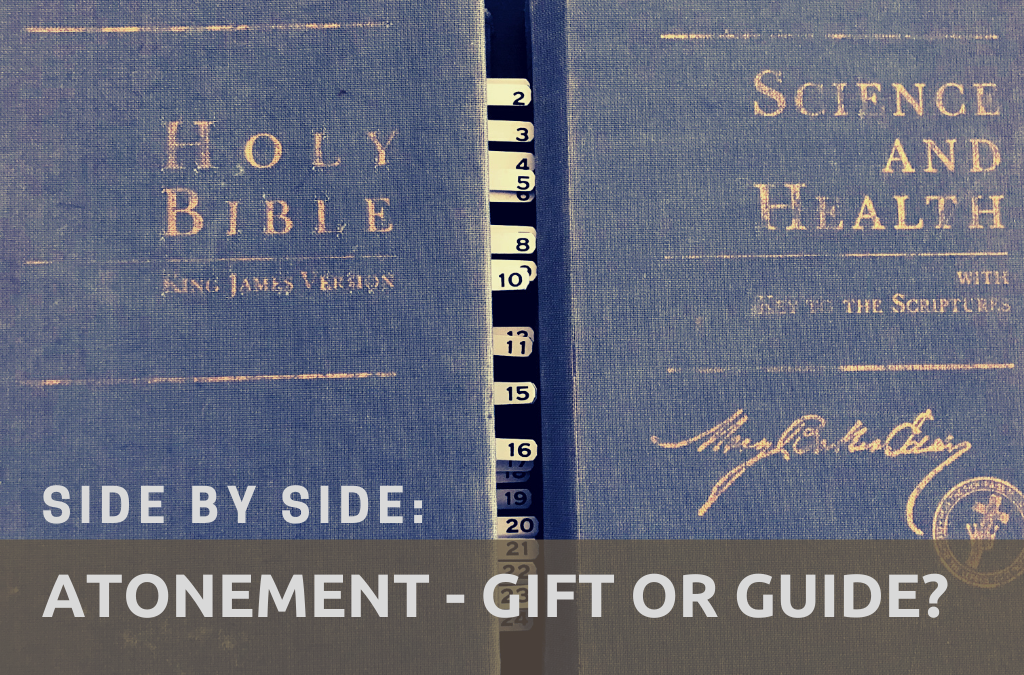
Both Science and Health and the Bible describe Jesus Christ’s death on the cross as an atonement. Looking at these texts side by side, we’ll consider whether they are telling the same story.
Jesus’ atonement is addressing a PROBLEM.
Science and Health states that the problem is a belief in matter – sin, disease, and death. Specifically, the problem is of wrong belief.
“We acknowledge God’s forgiveness of sin in the destruction of sin and the spiritual understanding that casts out evil as unreal. But the belief in sin is punished so long as the belief lasts.” S&H 497
The Bible states that sin itself is the problem and that every human is tainted with sin.
“as it is written: ‘None is righteous, no, not one; no one understands; no one seeks for God. All have turned aside; together they have become worthless; no one does good, not even one.’” Romans 3: 10-12 (ESV)
Jesus’ atonement serves a FUNCTION.
Science and Health explains that Jesus’ work on the cross proves the nothingness of matter. Jesus demonstrated the unreality of matter, sin, disease, and death. Jesus exemplifies a changed belief.
“We acknowledge that the crucifixion of Jesus and his resurrection served to uplift faith to understand eternal Life, even the allness of Soul, Spirit, and the nothingness of matter.” S&H 497
The Bible explains that by paying the debt of our sin on the cross, Jesus accomplishes salvation for us through His death and resurrection. So the Bible teaches the atonement deals with the problem of sin. This is something we could not do on our own.
I John 4: 10 “In this is love, not that we have loved God but that he loved us and sent his Son to be the propitiation for our sins.” (EVS)
*Propitiation: “The word propitiation carries the basic idea of appeasement or satisfaction, specifically toward God. Propitiation is a two-part act that involves appeasing the wrath of an offended person and being reconciled to him.” https://www.gotquestions.org/propitiation.html
Jesus’ atonement addresses our RELATIONSHIP with God.
Science and Health celebrates that Jesus’ atonement on the cross shows us the way to “at-one-ment” with God. We receive directions helpful for our journey to salvation.
“Jesus of Nazareth taught and demonstrated man’s oneness with the Father, and for this we owe him endless homage. His mission was both individual and collective. He did life’s work aright not only in justice to himself, but in mercy to mortals, — to show them how to do theirs, but not to do it for them nor to relieve them of a single responsibility.” (S&H 18)
The Bible celebrates that Jesus’ atonement through his sacrificial death on the cross pays our debt making us right with God. This is something we couldn’t earn on our own. It’s a gift to be received by faith.
Romans 3: 24-25: “and are justified by his grace as a gift, through the redemption that is in Christ Jesus, whom God put forward as a propitiation by his blood, to be received by faith.” (ESV)
Let’s Consider the Differences Side by Side:
- PROBLEM: Belief vs. Sin
- FUNCTION: Changed Belief vs. Debt Paid
- RELATIONSHIP: Guide for Attaining “at-one-ment” with God vs. Gift of Accomplished Atonement Making us Right with God
*Webster’s dictionary defines atonement as “reparation for a wrong or injury.” This requires a wrong made right through a specific action.
So what?
Is there a large difference between a gift or a guide? You’ll likely receive a grimace from anyone who’s bought a dining room table from Ikea if you tell them that there is no difference between a fully made table and directions alongside a factory-boxed table bearing thousands of pieces and screws. More than this, I ask you to consider while looking at these texts side by side, are they even making the same “table?” Is Science and Health telling the same story as the Bible?
Read the Bible on its own and consider which story it tells.
For while we were still weak, at the right time Christ died for the ungodly. For one will scarcely die for a righteous person—though perhaps for a good person one would dare even to die— but God shows his love for us in that while we were still sinners, Christ died for us. Since, therefore, we have now been justified by his blood, much more shall we be saved by him from the wrath of God. For if while we were enemies we were reconciled to God by the death of his Son, much more, now that we are reconciled, shall we be saved by his life. More than that, we also rejoice in God through our Lord Jesus Christ, through whom we have now received reconciliation.
Therefore, just as sin came into the world through one man, and death through sin, and so death spread to all men because all sinned—for sin indeed was in the world before the law was given, but sin is not counted where there is no law. Yet death reigned from Adam to Moses, even over those whose sinning was not like the transgression of Adam, who was a type of the one who was to come. But the free gift is not like the trespass. For if many died through one man’s trespass, much more have the grace of God and the free gift by the grace of that one man Jesus Christ abounded for many.
Other Resources to consider:
- Histories and Theories of Atonement – The Gospel Coalition
- Substitutionary Atonement – The Gospel Coalition
- The Doctrine of Atonement in the Bible – Crossway
- Propitiation – Gospel Coalition
I encourage you to receive Jesus’ gift of atonement freely given to all who repent of your sin and believe the Gospel.