
A Book Review and Personal Reflection by John Andrews
“I alone have escaped to tell you.” This is the refrain three times in the first chapter of the Book of Job when wide-eyed survivors bring the old man ever-grim reports from the scene of the tragedy. It has become a life verse for me since escaping Christian Science.
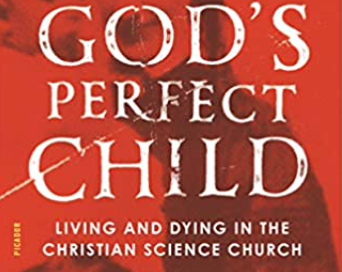
For others’ benefit, I’ve sought to testify from firsthand experience of the tragic harms done by the Mary Baker Eddy belief system over the past 150 years in America and worldwide. I am better equipped to do that due to the witness borne by journalist Caroline Fraser in her powerful book, God’s Perfect Child: Living and Dying in the Christian Science Church.
Christian Science as a religious movement and way of life is a little world of its own—distinctly separate from, though embraced within, the ordinary world everyone else lives in. That separateness is enforced by CS having its own specialized vocabulary, its own sacred book effectively superseding the Bible, its own health code, and its own tightly policed index of impermissible thoughts, by which intellectual curiosity and doctrinal doubts are flatly forbidden.
The Eddy system thus becomes a self-reinforcing worldview, very difficult to step outside of at all, let alone completely discard and shake off. This is where I found Fraser’s book so valuable. It gives the former Christian Scientist a vantage point from which to look back into that bubble we escaped from and see it as it affected one woman’s entire life.
An accomplished writer and researcher, formerly on the staff of The New Yorker, Caroline Fraser first sets the scene in her own happy Christian Science childhood (having turned away by age 20, one gathers from CS and religion in general.) But beneath that homelife grew her highly educated Father’s rigorous adherence to CS, leading to untreated gangrene in his foot, amputation, and eventually premature death. Fraser tells her story and that of the growth of CS; she documents in great detail across more than 400 pages, Mrs. Eddy’s biography, the phenomenal growth of CS up to the founder’s death in 1910, the movement’s faltering momentum thereafter, CS setbacks after 1970, and efforts at reinventing itself as the year 2000 approached—where the book ends.
Thus we have in God’s Perfect Child both her personal history within the history and a map of CS. Fraser recognizably but rather neutrally depicts the oddities of “planet CS” as we’ve all lived them. She locates Christian Science beliefs within contemporary thought but wastes little time arguing with them.
She tries to follow the facts where they lead, taking, it seemed to me, as mild a tone and as fair-minded and honest a stance as she can, by no means friendly but not hostile either. The facts lead, to a most unflattering picture of human credulity and the resulting harm done by Mary Baker’s creation of CS, less than two centuries ago.
Were there good intentions, lives well lived, blessings received, and situational improvements that one could call healings? In countless instances, yes, no doubt. But at the same time, so many lies and delusions, so much self-seeking and greed, such dreamy self-deception and the callous disregard of suffering—help, let me out of here! You mean to say I once believed this?
And that’s why I say, taking no pleasure in doing so, that this firehose of cold realism has been precisely the right book at the right time for my current need for post-CS spiritual growth. It leaves my often too-cozy rationalization of Christian Science as “not entirely good, granted, but not all that bad either,” with no place to hide.
Even 30 years after leaving the church, I still sometimes discern in myself a sort of gravitational pull to make excuses for CS denialism and the unnecessary hardship it has inflicted upon so many for so long. Yet, within that bubble, I had some happy times, cherished associations with family and friends, and exhilarating seasons of soldiering faithfully for what seemed a worthy cause.
When confronted with an unsparing critique of this or that aspect of Christian Science—unauthorized biographies of Mrs. Eddy, bleak statistics on CS healing claims, seamy insider accounts of Boston dysfunction—it was easier for me back then (and alarmingly, sometimes even now) to dismiss them as slanted, not quite fair, perhaps even godless and malicious, than to face them head on. The Fraser book, recounting the whole tangled story in one place, has helped me push past that.
There was a task of forgiveness I’d been postponing for way too long. I needed to forgive my parents and their parents, my teachers at Principia, numberless practitioners and CSB’s (Christian Science teachers), even Mrs. Eddy, I guess—and to forgive myself—for the monumental mass of falsehood and folly that was and is Christian Science.
I’ve clung, without realizing it, to various shiny objects, hoarded keepsakes, from the CS period of my life that seemed to confer upon me a sense of worthiness and significance that I was afraid to let go of. I must have feared that to flatly invalidate the entire Christian Science “thing” would be, at the same time, to invalidate myself in the bargain.
So while I could readily profess, with St. Paul, that “I am crucified with Christ, nevertheless I live… they that are Christ’s have crucified the flesh with the affections and lusts” (Galatians 2:20 and 5:24), I was still doing so with my fingers crossed behind my back. I hadn’t stopped secretly deriving part of my identity from the solid, secure genealogy of the Andrews clan, born and bred to Eddyism.
I had bought God’s Perfect Child in 1998 when it first came out, browsed through parts of it, and put it aside. I took note of the book again several years ago when Caroline Fraser brought out a new edition with an afterword about her Father’s agonizing death under Christian Science treatment. Only this year, however, in the summer of 2022, did I read the book in full—and it hit me hard.
I came away feeling soiled and stained by the stew of illusions and lies that the CS movement has foisted on the world across the whole span of its presence in American life. I was filled with an odd, numbing emptiness where my “not that bad and in many ways pretty good” fallback position as an ex-CSer used to be. I now see that God was using the book to draw me nearer him—him alone.
If God’s forgiveness of my sins, through Jesus Christ crucified and risen, was as boundless as I professed to believe it was, then my religious past must be fully cleansed in his sight. His forgiveness of me is the basis for the forgiveness I want to extend upon myself and others. Even the unnecessary loss of a parent in their 50s, under CS “radical reliance,” something that befell both my wife and me, is forgivable under our gracious Father’s atonement in his Son. Even our undiminished hypnotic loyalty to CS after those tragedies is forgivable!
My experiences this year, showing me new horizons of total reliance on our triune God for my identity, worth, and purpose, are parallel to the deepening humility Paul gained as he did ministry and matured spiritually. In his letters, as if descending a stairway, he goes from calling himself an apostle, to asserting he is unfit to be so called, to saying he is less than the least of saints, to finally insisting he is the chief of sinners (Gal. 1:1, I Cor. 15:9, Eph. 3:8, I Tim. 1:15).
I can relate, and my cathartic encounter with the Fraser book has been part of that needed process of self-reproach and cold reappraisal. As John the Baptist said of Jesus, “He must increase, but I must decrease” (John 3:30). We all must. Whatever elegant apparel of religiosity we once paraded in—in my case, the garb of an over-achieving Christian Scientist—must go in the rag bin before we can don the white robes Jesus offers us.
It has been wisely said that for the Christian, the opposite of faith is not doubt; rather, it is self-reliance. Or self-salvation, as I have come to realize in escaping Christian Science. Caroline Fraser argues at the close of God’s Perfect Child that we should expect the damaging societal effects of CS to be persistent and widespread though unseen, even as the movement itself, the CS brand name, withers away—because “in American life, extreme self-reliance is here to stay.” And alas, she’s probably right. One more reason her book belongs on your shelf.