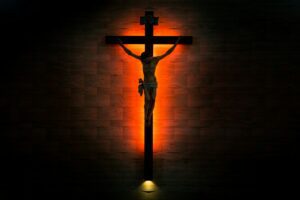

At Easter, Christians celebrate the historical event of Jesus’ painful crucifixion on the cross and his joyous resurrection from the grave. More than a miracle, Jesus’ death and resurrection are the climax of God’s larger story of redemption through Jesus’ atoning work of forgiving our sins and reconciling us with God.
Often people ask, Do Christian Scientists Celebrate Easter? The answer to the question is complicated, especially as we consider what Christian Scientists believe about the cross.
In practice, Christian Science focuses on Jesus’ resurrection and downplays the importance of His crucifixion. We will look at three challenges the cross presents the Christian Scientist and consider Scripture’s response.
We’ll consider the first challenge here.
CHALLENGE #1: The cross requires Jesus’ physical death and shed blood. (Hebrews 10:1-24)
The crucifixion was a brutally painful and bloody death. Christian Science believes in the unreality of the physical body, blood, and death. Clinging to a “spiritual” reality, Eddy writes, “Man is not matter; he is not made up of brain, blood, bones, and other material elements” Science and Health (S&H), 475.
In light of this core belief, Christian Science reframes the story of the cross. Though it teaches that the crucifixion was an important event in Jesus’ healing ministry, Christian Science dismisses that anything unique was accomplished through Jesus’ physical death and shed blood. Eddy explains,
The material blood of Jesus was no more efficacious to cleanse from sin when it was shed upon ‘the accursed tree,’ than when it was flowing in his veins as he went daily about his Father’s business. S&H, 25.
Eddy denies that anything unique was accomplished on the cross because she reframes the cross’ purpose. Christian Science teaches that on the cross, Jesus demonstrated what he constantly proved through his healing ministry, the unreality of sin, disease, and death. There’s even debate to whether Eddy teaches that Jesus died on the cross. It may be more accurate to say that Christian Scientists believe that Jesus died to “mortal sense” on the cross by claiming the “allness” of God, eternal Life, and demonstrating over the false belief in matter. Eddy explains the purpose of the cross for the Christian Scientist in the fifth tenet,
We acknowledge that the crucifixion of Jesus and his resurrection served to uplift faith to understand eternal Life, even the allness of Soul, Spirit, and the nothingness of matter. S&H, 497.
In contrast, Scripture teaches that Jesus’ physical death and shed blood are essential for our salvation.
Scripture emphasizes the physicality of Jesus’ bloody, painful, and sacrificial death. Each Gospel describes in detail the mocking, humiliation, and suffering Jesus endured on the cross for our salvation. Throughout the New Testament, the Gospel is proclaimed that Jesus Christ died for our sins. Paul exhorts:
Now I would remind you, brothers, of the gospel I preached to you, which you received, in which you stand, and by which you are being saved, if you hold fast to the word I preached to you—unless you believed in vain. For I delivered to you as of first importance what I also received: that Christ died for our sins in accordance with the Scriptures, that he was buried, that he was raised on the third day in accordance with the Scriptures. 1 Corinthians 15: 1-4
Scripture emphasizes the crucifixion over and over because Jesus’ atoning work for us could never occur without his shed blood on the cross. Scripture explains that Jesus is the ultimate sacrificial lamb, the only perfect one who could fulfill the requirements of atonement for us. The Old Testament sacrificial system required ongoing sacrifices. Jesus’ death replaced that requirement once and for all. For those who believe, the cross satisfies God’s justice for all time.
. . . without the shedding of blood there is no forgiveness of sins. Hebrews 9: 22.
Also, check out:
- The Significance of the Blood of Jesus by former Christian Scientist Lauren Hunter.
- What is the Meaning of the Blood of Jesus
- The Power and Importance of the Blood of Jesus
- Blood of Jesus Verses
Do you believe Jesus willingly suffered death on the cross so you might be forgiven?
As you consider these things, I encourage you to read Isaiah’s prophetic words that anticipated Jesus’ atoning work on the cross. I hope you see how personal Jesus’ love for us is through his suffering for each of us.
Isaiah 53
Who has believed what he has heard from us?
And to whom has the arm of the Lord been revealed?
For he grew up before him like a young plant,
and like a root out of dry ground;
he had no form or majesty that we should look at him,
and no beauty that we should desire him.
He was despised and rejected by men,
a man of sorrows and acquainted with grief;
and as one from whom men hide their faces
he was despised, and we esteemed him not.
Surely he has borne our griefs
and carried our sorrows;
yet we esteemed him stricken,
smitten by God, and afflicted.
But he was pierced for our transgressions;
he was crushed for our iniquities;
upon him was the chastisement that brought us peace,
and with his wounds we are healed.
All we like sheep have gone astray;
we have turned—every one—to his own way;
and the Lord has laid on him
the iniquity of us all.
He was oppressed, and he was afflicted,
yet he opened not his mouth;
like a lamb that is led to the slaughter,
and like a sheep that before its shearers is silent,
so he opened not his mouth.
By oppression and judgment he was taken away;
and as for his generation, who considered
that he was cut off out of the land of the living,
stricken for the transgression of my people?
And they made his grave with the wicked
and with a rich man in his death,
although he had done no violence,
and there was no deceit in his mouth.
Yet it was the will of the Lord to crush him;
he has put him to grief;
when his soul makes an offering for guilt,
he shall see his offspring; he shall prolong his days;
the will of the Lord shall prosper in his hand.
Out of the anguish of his soul he shall see and be satisfied;
by his knowledge shall the righteous one, my servant,
make many to be accounted righteous,
and he shall bear their iniquities.
Therefore I will divide him a portion with the many,
and he shall divide the spoil with the strong,
because he poured out his soul to death
and was numbered with the transgressors;
yet he bore the sin of many,
and makes intercession for the transgressors.
I would love to talk more with you about what it means to have a real relationship with the real, living God. Please email me at Katie@FFCSministry.org.